 how-to
Microneedling for Acne Scars: A Step-by-Step Guide
Table of Contents
- How Microneedling for Acne Scars Works
- Which Acne Scar Types Respond Best
- How Many Microneedling Sessions for Acne Scars
- Microneedling Aftercare: What to Avoid and When
- Microneedling vs. CO2 Laser for Acne Scars
- Microneedling for Acne Scars Before and After: Setting Realistic Expectations
- Is Microneedling for Acne Scars Right for You?
- Frequently Asked Questions
Last Updated: October 5, 2026
How Microneedling for Acne Scars Works
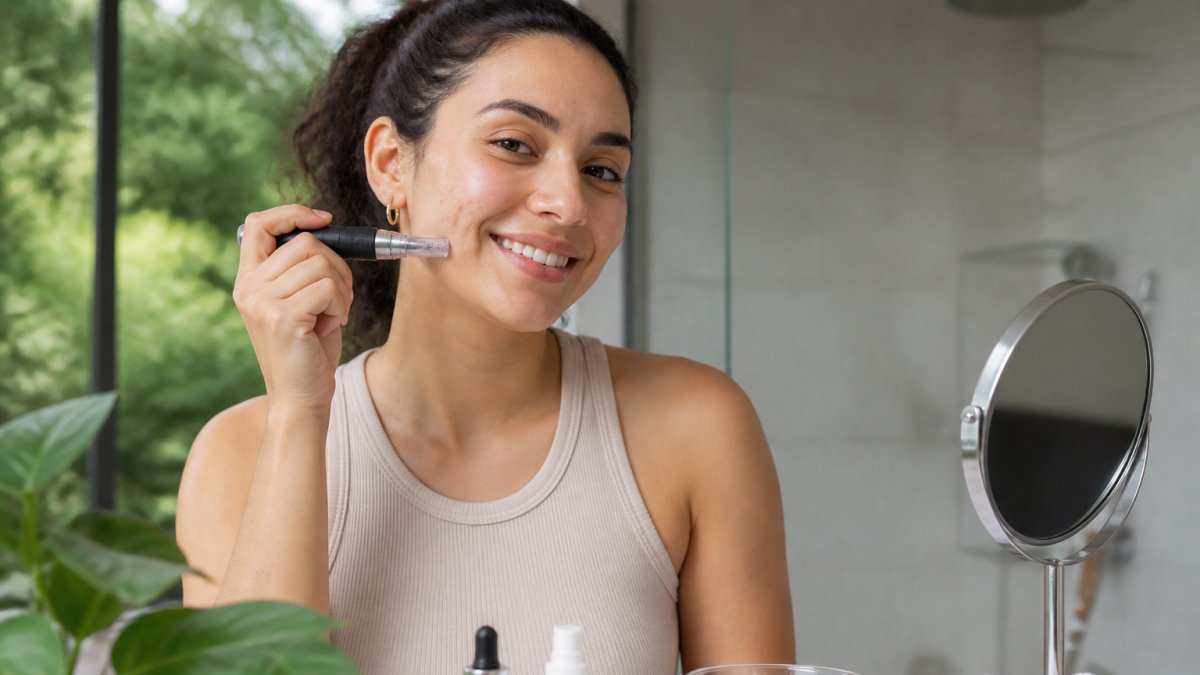
Microneedling for acne scars is a treatment that uses fine needles to create tiny wounds in the skin, triggering your body's natural repair process to rebuild collagen and smooth scar tissue.
Here is how it works, step by step:
- A trained provider cleanses your skin and applies a numbing cream
- A device with fine needles passes over the treatment area
- The needles create micro-channels in the top layers of skin
- Your body responds by sending collagen and elastin to heal those micro-injuries
- Over weeks, new skin cells fill in pitted areas and soften scar edges
The key point: microneedling does not remove scar tissue. It rebuilds the skin around and beneath it.
That distinction matters. Many people expect scars to disappear. In reality, the treatment softens edges, improves skin texture, and reduces scar depth over time.
Collagen production peaks weeks after each session, not on the day of treatment. This is why results build gradually. The American Academy of Dermatology's guide to microneedling notes that collagen remodeling continues for months after a session.
Which Acne Scar Types Respond Best
Not all acne scars respond the same way. The best results come from atrophic scars, which sit below the skin surface.
Atrophic scars are depressions in the skin. They include:
- Pitted scars with sharp, defined edges
- Rolling scars with soft, wave-like depressions
- Boxcar scars with flat, shallow bases
These types respond well because microneedling triggers collagen right where the skin has lost volume.
Hypertrophic scars are raised and firm. They respond less predictably and often need a different approach.
Pigmented scars are flat marks left by old breakouts. These are not true scars. They are color changes, and they often fade on their own or with other treatments.
A careful examination before treatment matters more than the device itself. Your provider should map each scar type on your face, because most people have a mix.
How Many Microneedling Sessions for Acne Scars
Most people need three to six sessions for visible improvement in acne scarring, with a common range of four to six when scars are deep or mixed.
Each session triggers a wound-healing cascade.
Here is what drives the count:
| Factor | Fewer Sessions | More Sessions |
|---|---|---|
| Scar depth | Shallow, surface-level | Deep, pitted |
| Scar type | Rolling or boxcar | Ice-pick or mixed |
| Scar tethering | Scar moves freely with skin | Scar anchored to deeper tissue |
| Skin response | Strong collagen response | Slower healing |
| Treatment area | Small, focused area | Full cheeks or face |
| Spacing | Consistent four-to-six-week schedule | Gaps between visits |
Two factors deserve more attention than they usually get.
Tethering. Some scars are pulled downward by fibrous bands that connect the surface to deeper tissue.
Needle depth. Depth is set per treatment area, not per face.
Progress is often uneven. One cheek may improve faster than the other. Some scars soften after two sessions, while others hold on longer.
If you are wondering how many sessions you personally need, a consultation is the only honest answer. Anyone quoting a fixed number before seeing your skin is guessing.
Microneedling Aftercare: What to Avoid and When
Aftercare decides how well your skin heals. The first 24 to 72 hours matter most, but what you do in the week before treatment also shapes the result. Here is the full arc, before, during, and after, that most guides leave out.
Before your session
- One week out: Stop retinoids, exfoliating acids (glycolic, salicylic, lactic), and any at-home peeling products. These thin the skin barrier and increase the risk of irritation during treatment.
- Three to five days out: Avoid prolonged sun exposure and skip waxing, threading, or chemical depilatories on the treatment area.
- 24 hours out: No alcohol, no blood-thinning pain relievers such as aspirin or ibuprofen unless your provider says otherwise, and no shaving over the treatment area.
- Day of: Arrive with clean skin. No makeup, no moisturizer, no sunscreen on the treatment area unless your provider instructs otherwise.
Tell your provider about any active cold sore history. Microneedling over a site where herpes simplex has appeared before can trigger an outbreak, and many practitioners prescribe an antiviral before treatment for patients with that history.
During the session
A typical professional session runs 30 to 60 minutes depending on treatment area. Your provider cleanses the skin, applies a topical numbing cream for 20 to 30 minutes, then passes the device in multiple directions, vertical, horizontal, and diagonal, to create an even pattern of micro-channels. Depth is adjusted per area. Expect mild pinpoint bleeding, which is normal and signals that the needles reached the intended layer. Many providers finish with a topical serum or growth factor product applied directly into the micro-channels.
After your session
Your provider will give you specific instructions, but here is the general framework for aftercare:
- First 24 hours: Skip makeup, exercise, and swimming. Cleanse with a gentle, fragrance-free cleanser and apply a bland moisturizer.
- First 48 hours: Avoid direct sun and harsh skincare products. Do not use ice packs directly on the skin, wrap them if you use them at all.
- First week: No retinoids, exfoliants, or active ingredients. No facial scrubs, cleansing brushes, or alcohol-based toners.
- Ongoing: Wear sunscreen daily, without exception. Mineral sunscreens with zinc oxide or titanium dioxide tend to be better tolerated on freshly treated skin than chemical formulas.
Redness and mild swelling are expected. They usually settle within a few days. Some pinpoint bruising can occur, especially with deeper passes, and typically fades within a week.
What most guides miss is how much sunscreen affects your final result. Fresh skin is more sensitive to UV damage. Sun exposure during healing can darken the treated area and undo weeks of progress. This is especially true for patients with medium to deep skin tones, where post-inflammatory hyperpigmentation is a real risk.
Avoid these until your provider clears you:
- Saunas, steam rooms, and hot yoga
- Facial scrubs and cleansing brushes
- Alcohol-based toners
- Any product with retinol or glycolic acid
- Intense cardio or heavy lifting for the first 48 hours
Warning signs that need a call to your provider
Most reactions are temporary. Contact your provider promptly if you notice:
- Spreading redness, warmth, or swelling beyond the first few days
- Pus, foul odor, or a fever, possible signs of infection
- A cold sore outbreak in or near the treated area
- Blistering, crusting, or darkening that does not fade
- Any reaction that feels worse on day three than it did on day one
These are uncommon, but knowing what to watch for is part of a safe treatment plan.
Microneedling vs. CO2 Laser for Acne Scars
Microneedling and CO2 laser both treat acne scars, but they differ in downtime, risk, and intensity. CO2 laser removes the top layer of skin and can deliver strong results in fewer sessions. It also comes with more downtime, more discomfort, and a higher risk of pigment changes.
Here is the honest comparison:
| Factor | Microneedling | CO2 Laser |
|---|---|---|
| Downtime | 1-3 days of redness | 1-2 weeks of healing |
| Comfort | Numbing cream manages most discomfort | Often needs stronger pain control |
| Sessions | 3-6 | 1-3 |
| Skin types | Safe for most skin tones | Higher risk on darker skin |
| Best for | Texture, mild to moderate scarring | Deep, stubborn scarring |
For many patients, microneedling is the better starting point. It is gentler, carries lower risk of pigmentation problems, and works across a wider range of skin tones.
CO2 laser still has a place. Deep, tethered scars sometimes need that level of resurfacing. The trade-off is real: more results, more recovery.
Radiofrequency microneedling sits between the two. It adds heat energy to the needles, which can boost collagen remodeling for tougher scars.
Microneedling for Acne Scars Before and After: Setting Realistic Expectations
Results are gradual, and that is the most important thing to understand. You will not see a dramatic change the week after your first session.
Here is a realistic timeline:
- Week 1-2: Redness fades, skin may feel smoother
- Week 4-6: Early collagen response becomes visible
- Month 3: Meaningful texture improvement after multiple sessions
- Month 6: Full results from a completed series
What improvement actually looks like: scars look softer, edges blur, and skin reflects light more evenly. Makeup sits better. Pores appear smaller.
What it does not look like: flawless skin. Deep ice-pick scars may only improve partially. Some texture may remain.
The U.S. Food and Drug Administration's guidance on microneedling devices classifies microneedling devices by their intended use, which is why results claims should always come from a qualified provider, not marketing copy.
Is Microneedling for Acne Scars Right for You?
Microneedling is not right for everyone. A careful exam and honest conversation should come before any treatment plan.
You may be a good candidate if you:
- Have atrophic or pitted acne scars
- Have uneven skin texture or enlarged pores
- Have realistic expectations about gradual results
- Can commit to multiple sessions and aftercare
You should avoid or delay treatment if you:
- Have active acne or open wounds in the area
- Are pregnant or breastfeeding
- Have a history of keloid scarring
- Take blood-thinning medication
- Have an active skin infection
At Coastal Aesthetics NY, every treatment plan starts with a consultation.
One patient, Clarice Turner, put it simply: "Coastal Aesthetics NY made the entire experience easy and comfortable from start to finish. The team was professional, attentive, and truly focused on my goals."
If you have deeper scars or want faster results, combining microneedling with other treatments, such as PRP or chemical peels, can target different layers of the skin.
Frequently Asked Questions
Does microneedling actually fix acne scars?
Microneedling can improve many acne scars, especially atrophic or pitted types, by creating controlled micro-injuries that trigger collagen and elastin production. It softens scar tissue and refines skin texture over multiple sessions. It does not erase scars completely, and results vary by scar depth and skin type. A consultation with a qualified provider helps determine whether microneedling for acne scars is appropriate for your specific scarring.
How many microneedling sessions are needed for acne scars?
Most people need a series of sessions spaced four to six weeks apart, often three to six treatments, to see meaningful scar improvement. The exact number depends on scar depth and skin response. Some patients notice gradual improvement after the first few sessions, while deeper pitted scars may require additional treatments or combination approaches.
What should you avoid after microneedling?
For the first 24 to 48 hours, avoid direct sun exposure, strenuous exercise, saunas, and active skincare ingredients like retinoids, exfoliating acids, and vitamin C. Use a gentle cleanser, a bland moisturizer, and broad-spectrum sunscreen. Do not pick or scrub treated skin. Following microneedling aftercare instructions from your provider supports healing and lowers the risk of irritation or pigmentation changes.
Which is better for acne scars, CO2 laser or microneedling?
CO2 laser typically delivers more dramatic results in fewer sessions but involves significant downtime, redness, and a higher risk of pigmentation issues, especially in darker skin tones. Microneedling, including radiofrequency microneedling, offers gradual improvement with minimal downtime and a lower risk profile. The better choice depends on scar severity, skin tone, budget, and how much downtime you can accept. A provider can help you weigh microneedling vs. CO2 laser for acne scars based on your goals.
Acne scarring is stubborn, and no single treatment erases it overnight. But a personalized plan built around your scar types, skin tone, and schedule can make a real difference. Coastal Aesthetics NY offers microneedling, PRP, collagen-stimulating treatments, and chemical peels, all performed by board-certified Nurse Practitioners who tailor each plan to your goals. Book your consultation and get an honest assessment of what your skin needs.