 How-to
7 PRP for Hair Loss Results Timeline Stages to Expect
Last Updated: October 30, 2026
Quick Summary
The PRP for hair loss results timeline starts with temporary shedding around weeks two to four, followed by reduced shedding at weeks four to eight. Visible density changes often appear between months two and four, with peak fullness reported between roughly six and twelve months.
- Do not judge PRP at week four, since early shedding is expected and temporary.
- Hair grows roughly half an inch per month, so early anagen re-entry shows cosmetically at months four to six.
- A common induction series is three to four sessions spaced about four weeks apart.
- Smoking, poor protein and iron intake, and inconsistent session spacing can slow the timeline.
- Take photos monthly, not weekly, because weekly photos show noise rather than progress.
Table of Contents
- What the PRP Hair Results Timeline Actually Looks Like
- PRP Hair Growth Results Month by Month
- How Many PRP Sessions for Hair Loss Do You Need?
- PRP Hair Treatment Before and After: What Changes to Track
- Factors That Change How Fast PRP Works
- PRP Hair Treatment Maintenance and Follow-Up Schedule
- Booking Your PRP Consultation at Coastal Aesthetics NY
- Frequently Asked Questions
What the PRP Hair Results Timeline Actually Looks Like
Most people considering PRP for hair loss want one thing: a realistic PRP for hair loss results timeline. The PRP for hair loss results timeline is not a single date. It is a series of stages, and each stage looks different.
Here is the short version: shedding often comes first, visible change comes later, and patience is part of the protocol.
How Platelet-Rich Plasma Stimulates the Follicle
PRP is an autologous treatment, meaning it uses your own blood. A small sample is processed to concentrate platelets and growth factors, which are then injected into the scalp.
Those growth factors support hair follicle stimulation in a few ways:
- They are thought to encourage blood flow around the dermal papilla, the structure that feeds each follicle
- They are thought to support the anagen phase, the active growth stage of the hair regrowth cycle
- They may help slow hair miniaturization, where thick strands thin into fine ones
PRP does not create new follicles. It is generally understood to support the ones you still have, which is why many practitioners favor earlier treatment.
PRP Hair Growth Results Month by Month
The PRP hair growth results month by month picture is gradual, not dramatic. Hair grows slowly, and no injectable treatment can rush the biology of the hair regrowth cycle.
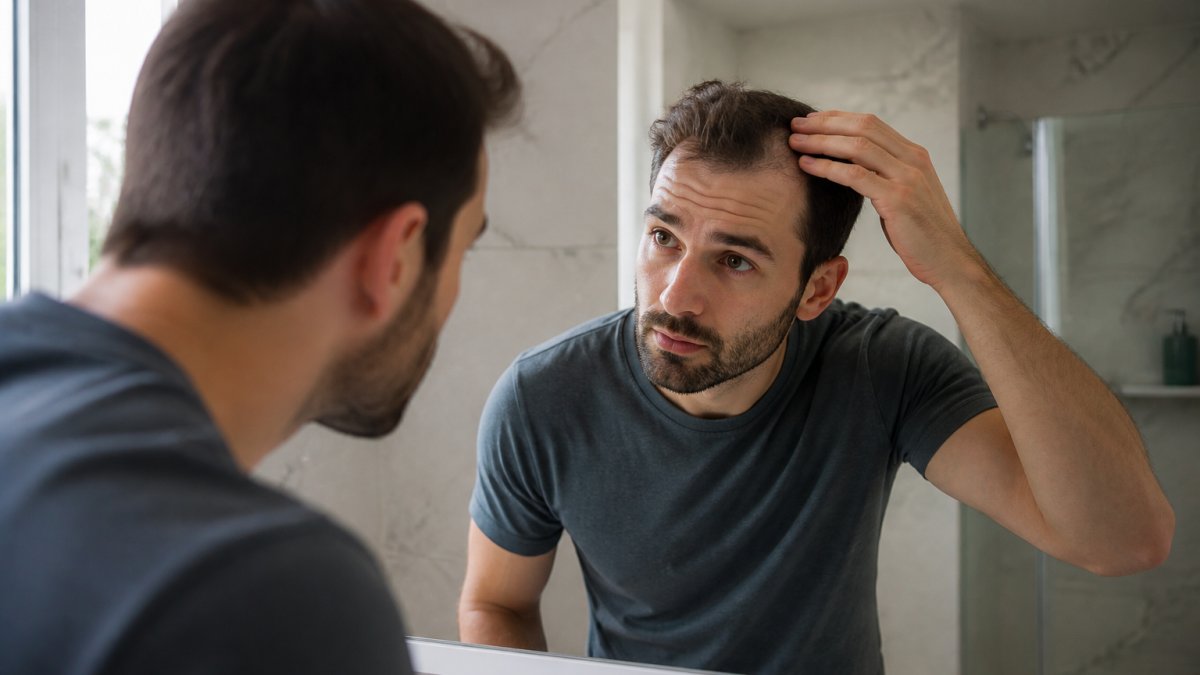
Weeks 1-2: The Inflammatory and Shedding Phase
The first two weeks are the least intuitive part of the timeline. The micro-injections create a controlled, localized inflammatory response, that is part of how PRP works, not a complication. Growth factors from the concentrated platelets are believed to begin signaling around the dermal papilla, and some patients notice mild scalp tenderness, tightness, or pinpoint redness at injection sites for a short period.
Shedding is common in this window and often peaks around weeks two to four. First, the trauma of injection can push hairs already in the telogen (resting) phase to release earlier than they would have. Second, patients who begin PRP while an active shedding episode is underway, telogen effluvium after illness, stress, or a hormonal shift, will keep shedding on the underlying condition's schedule regardless of PRP.
Weeks 3-8: Reduced Shedding Is the First Real Signal
The earliest measurable change is usually not new growth, it is less loss. Around weeks four to eight, many patients notice fewer hairs on the pillow, in the shower drain, and on the brush.
Providers may use objective measures such as standardized photos or a hair pull test to track changes over time, since subjective impressions can be unreliable at this stage.
Months 2-4: Early Visible Change
Visible improvement is often reported between months two and four, and it tends to be subtle. Early changes may include slightly better density in some areas, which can show up in standardized photos before they are noticeable in a mirror.
Hair grows roughly half an inch per month, so a follicle that re-enters anagen in month two will not produce a cosmetically meaningful strand until months four to six. That lag is biology, not a slow clinic.
Months 4-6: Thickness and Coverage Become Measurable
By around month six, some patients report changes in hair thickness and coverage. Providers may use trichoscopy, a magnified scalp exam, to compare hair against baseline images, which can be more objective than memory alone. Peak fullness is often reported between roughly six and twelve months, depending on the individual and the treatment plan.
Months 6-12: Peak Response and the Plateau Question
Peak response is often reported between months six and twelve, after which results may level off. Ongoing maintenance is commonly discussed as an important factor in sustaining results over time.
What Slows the Timeline Down
A few factors reliably push results later: advanced miniaturization at baseline (less follicle to support), ongoing untreated shedding drivers, smoking (which impairs microcirculation), poor protein and iron intake, and inconsistent session spacing. None of these make PRP useless, they make the timeline longer and the case for combining therapies stronger. Our guide to PRP for hair loss side effects covers what to expect after each session.
How Many PRP Sessions for Hair Loss Do You Need?
Most PRP hair treatment plans start with a series, not a single session.
The exact number depends on your stage of hair loss, your follicular health, and how your scalp responds. Some patients need more sessions; others hold results with fewer.
Pricing depends on the number of sessions and individual treatment plan. You can also review flexible payment plans through Cherry to make treatment more affordable.
PRP Hair Treatment Before and After: What Changes to Track
PRP hair treatment before and after photos are useful, but they only tell part of the story. Good tracking means measuring the same things the same way over time.
Track these markers:
- Hair density at the part and crown, photographed under the same lighting
- Hair shedding counts on wash days
- Hair shaft thickness, which a provider can assess with trichoscopy, a magnified scalp exam
Take photos monthly, not weekly. Weekly photos show noise, not progress. For a closer look at what real change looks like over time, see our guide to PRP facial before and after results.
Factors That Change How Fast PRP Works
Two patients can follow the same protocol and see results at different speeds. That is normal. Biological variability is real, and it shapes your timeline more than most guides admit. What most guides skip is the part patients actually need: which variables are fixed, which are modifiable, and how to tell the difference before you spend a year guessing.
Fixed Variables: Genetics, Age, and Stage of Loss
Some inputs you cannot change, and pretending otherwise sets up disappointment.
- Genetics and hormone levels. Androgenetic alopecia, pattern hair loss driven by follicle sensitivity to dihydrotestosterone (DHT), is progressive. PRP can support follicles that are still responsive, but it does not block the hormonal driver. Patients with a strong family history and active progression usually need a medical therapy alongside PRP, not instead of it.
- Age and overall health. Cellular regeneration slows with age, and conditions that impair healing, uncontrolled diabetes, thyroid disease, iron-deficiency anemia, can blunt the response. A provider should screen for these before blaming PRP.
- Stage of hair loss. Advanced miniaturization limits what PRP can restore because the follicle itself is shrinking. Earlier treatment generally outperforms later treatment; this is the single most consistent pattern practitioners report.
Modifiable Variables: What You Actually Control
- Session spacing and compliance. A three-to-four session induction series spaced about four weeks apart works because it stacks growth-factor exposure during the early anagen transition. Stretching sessions to every eight weeks because of scheduling is one of the most common reasons a timeline stalls.
- Smoking. Nicotine constricts blood vessels and carbon monoxide reduces oxygen delivery, both work directly against the microcirculation PRP is trying to support. Patients who smoke often see a slower, flatter response.
- Nutrition. Hair is a protein structure. Adequate protein, iron (with ferritin checked, not just hemoglobin), vitamin D, and zinc support the raw materials of regrowth. Deficiencies are common and correctable.
Synergistic Treatments: Compressing the Timeline
This is the angle most timelines ignore. PRP is rarely used alone in practice, and combining it with evidence-based therapies can shorten the wait for visible change.
- Minoxidil (topical or oral). Minoxidil prolongs the anagen phase and increases follicle size; PRP supports the follicular environment. The mechanisms are complementary rather than redundant.
- Finasteride or other 5-alpha-reductase inhibitors (for appropriate candidates). These address the DHT driver that PRP cannot. For pattern hair loss, pairing the two treats the cause and the environment.
- Microneedling. Creating controlled micro-channels before PRP application may improve absorption and adds its own growth-factor signaling. Many clinics pair the two in the same visit.
A candid provider will tell you which combinations are appropriate for your diagnosis, and which are not, such as hormonal therapy in patients for whom it is contraindicated.
Failure Indicators: When to Stop or Change Course
Most articles never tell you when to walk away, which is how patients end up in a sunk-cost spiral. Watch for these signals rather than guessing:
- Shedding has not eased by month three. Persistent shedding past the early phase suggests an unresolved driver, telogen effluvium, thyroid dysfunction, iron deficiency, that needs its own workup.
- No density change by month six on standardized photos and trichoscopy. Subjective impressions are unreliable; objective comparison is the standard.
- Hair loss keeps progressing despite the series. Progression on treatment is information: it may mean the diagnosis needs revisiting, the protocol needs adjusting, or a synergistic therapy is missing.
A poor therapeutic response is information, not a dead end. It may mean adjusting the protocol, adding a synergistic treatment, or confirming the diagnosis. Before starting, it also helps to know what recovery looks like. Our article on PRP for hair loss side effects covers what to expect after each session.
PRP Hair Treatment Maintenance and Follow-Up Schedule
PRP hair treatment maintenance keeps results from fading. Hair loss is ongoing for most people, so a one-time series rarely holds forever.
A typical maintenance schedule looks like this:
| Phase | Timing | Purpose |
|---|---|---|
| Initial series | 3-4 sessions, about 4 weeks apart | Build the foundation |
| First follow-up | Month 3-4 | Assess early response |
| Progress check | Month 6 | Measure density and thickness |
| Maintenance | Every 3-6 months | Sustain results |
| Annual review | Once a year | Reassess the plan |
Treatment intervals are typically individualized based on response rather than a fixed calendar. Follow-up visits may include trichoscopy to compare hair density and shaft thickness over time.
Booking Your PRP Consultation at Coastal Aesthetics NY
A consultation is where the timeline becomes personal. At Coastal Aesthetics NY, our board-certified Nurse Practitioners work with you to build a personalized treatment plan around your goals and needs.
You can review our aesthetic and hair restoration services to see what we offer. When you are ready, contact our team to schedule a consultation.
Frequently Asked Questions
How soon can I expect to see results from a PRP hair treatment?
Most patients notice reduced shedding within the first four to six weeks, but visible hair density changes usually appear between months three and six. The PRP hair results timeline depends on your follicle health, the extent of thinning, and how consistently you follow the recommended session schedule. Changes in appearance often lag behind the biological response, so visible results may take some time.
How many PRP sessions for hair loss are typically recommended?
A common treatment approach in the industry involves an initial series of sessions followed by periodic maintenance. The number of sessions depends on the stage of alopecia, the response to treatment, and whether PRP is combined with other therapies. A consultation with a qualified provider can help determine an appropriate plan.
Can PRP cause shedding before hair growth improves?
Yes. A temporary increase in hair shedding during the first two to four weeks is common and does not mean the treatment failed. Temporary shedding after treatment is commonly reported and is generally expected to settle over time. If shedding persists or worsens, it is advisable to speak with a qualified provider for evaluation.
How long do PRP hair treatment results last?
Results typically hold for several months after the initial series, which is why PRP hair treatment maintenance matters. Without follow-up sessions, hair density tends to gradually decline back toward baseline as the growth factor effects fade. Many people maintain results with periodic sessions, and treatment intervals are typically individualized based on response and hair loss progression.
Hair loss rarely waits, and neither should your plan. Coastal Aesthetics NY combines Nurse Practitioner-led care, personalized treatment plans, and evidence-based PRP protocols to help you move from guesswork to a clear timeline. Get started with Coastal Aesthetics NY and book a consultation to map your own PRP hair restoration plan.